How to Recognize Signs From the Universe (Without Overthinking)

Tune Into the Signs: A Grounded Checklist for Noticing Guidance From the Universe
Noticing “signs” feels easier when there’s a simple structure: calm the noise, track patterns, and respond with small, practical next steps. This guide lays out a clear checklist-style approach for recognizing meaningful nudges, separating them from everyday randomness, and building trust in intuition without spiraling into over-interpretation.
What Counts as a “Sign” (and What Usually Doesn’t)
A sign is typically a moment of heightened relevance: it lands with clarity, repeats, or arrives right after a sincere question or decision point. Many people notice signs through repeating symbols, timely conversations, unexpected opportunities, strong bodily “yes/no” responses, dreams, and synchronicities that cluster.
What usually isn’t a sign: anything that creates panic, demands urgent action, or pressures harmful choices; one-off coincidences with no personal resonance; or content consumed while doom-scrolling. A helpful standard is simple: a sign supports agency and calm action, not fear or compulsive checking.
Prepare the Signal: Quick Ways to Get Clear Enough to Notice
Clarity is less about “receiving” something perfect and more about reducing static. Before asking for guidance, try a 60-second reset: slow breathing, unclench your jaw and shoulders, soften your gaze, and name the decision in one sentence. Keep the question clean: “What is the next supportive step?” tends to produce better insights than “Tell me exactly what will happen.”
Choose a time window to observe—often 24–72 hours is plenty—so life doesn’t turn into constant scanning. Set one boundary: no interpretation while highly emotional, sleep-deprived, or using anything that distorts perception. Then create a capture method (notes app or a small journal) with three lines: date, situation, and what happened.
If mindfulness helps you get steady, the National Center for Complementary and Integrative Health overview of meditation and mindfulness offers a grounded starting point.
The Checklist: How to Tell a Meaningful Nudge From Random Noise
Use this checklist like a filter. You’re not trying to prove something mystical; you’re trying to make a wise next move without getting yanked around by anxiety or coincidence.
- Resonance check: Does it feel like a quiet “click” in the body (relief, steadiness) rather than adrenaline or dread?
- Repetition check: Has it shown up at least 2–3 times across different contexts (not just in one app feed)?
- Timing check: Did it appear near a relevant choice, conversation, or intention you set?
- Neutrality check: Could this be confirmation bias? If yes, look for a second, independent indicator before acting.
- Action check: What small, low-risk step would honor the message? If the only “action” is obsessive decoding, pause.
- Values check: Does it align with personal values (respect, health, honesty) and not override common sense?
- After-effect check: Do you feel more grounded after acknowledging it, even if the decision is still hard?
Common “Sign” Types and a Grounded Response
| Sign type | How it can show up | Best next step | When to pause interpretation |
|---|---|---|---|
| Repeating symbols | Same word/animal/number across separate places | Write it down; ask what it connects to in current life | If it triggers compulsive checking or anxiety |
| Unexpected message | A friend mentions exactly what’s on the mind | Ask a clarifying question; consider practical implications | If it pressures a risky decision |
| Body intuition | Tightness vs. openness when considering an option | Try a small experiment step; reassess after sleep | If stress or exhaustion is high |
| Dreams | Themes repeating over weeks | Track themes; identify emotions and real-life parallels | If using dreams to avoid direct conversations |
| Synchronicity cluster | Several “too-timely” events in a short window | Look for the common thread; choose one grounded action | If it becomes a substitute for planning |
How to Work With Signs Without Overthinking
Overthinking often happens when a sign is treated like a command instead of information. Try the “one step rule”: respond with one realistic step (send an email, research an option, have a conversation) rather than trying to solve the entire future in your head.
Journaling Prompts That Strengthen Intuition Over Time
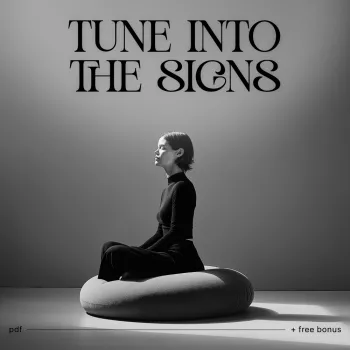
For a structured format that’s easy to revisit when decisions feel noisy, Tune Into the Signs – Checklist for How to Notice Signs From the Universe (Digital Download) keeps everything in one place: quick reset, observation window, and a decision-friendly checklist.
When to Seek Extra Support
If interpreting signs increases anxiety, disrupts sleep, or leads to compulsive behaviors, that’s a cue to step back and stabilize basics (sleep, nutrition, routine). The National Institute of Mental Health has practical guidance on coping with stress, which can help you return to a steadier baseline where clarity is more accessible.
It can also help to redefine intuition in grounded terms: the APA Dictionary of Psychology describes intuition as immediate understanding without conscious reasoning—useful, but still something to test gently with reality.
A Simple Way to Start Today
If the “next step” is financial (a common source of background stress that muddies intuition), a practical companion is The Beginner’s Guide to Taking Control of Your Money (Digital Download)—because clearer numbers often create clearer choices.
FAQ
How can signs be recognized without falling into confirmation bias?
Track observations with dates, look for repetition across different contexts, and avoid interpreting while dysregulated. Then respond with a small, reversible action rather than a big leap based on a single event.
What’s the difference between intuition and anxiety?
Intuition tends to feel calm and clear, while anxiety pushes urgency, fear, and worst-case certainty. If you’re sleep-deprived or emotionally flooded, delay interpretation and revisit after rest to see what remains steady.
How often should signs be asked for?
Ask occasionally and intentionally, tied to real decisions, then use a 24–72 hour window to observe. This keeps you from constant scanning and helps you evaluate patterns rather than isolated moments.















Leave a comment