Brave Beginnings: Build Courage to Try New Things

Brave Beginnings: A Practical Digital Guide to Trying New Things
Trying something new can feel risky—even when it’s something you genuinely want. The moment you consider a new class, hobby, style, social plan, or routine, your brain starts scanning for what could go wrong. That protective instinct isn’t a character flaw; it’s a system that prefers the familiar. The good news: courage doesn’t require a personality transplant. It can be built through small, repeatable steps that lower the stakes and create momentum.
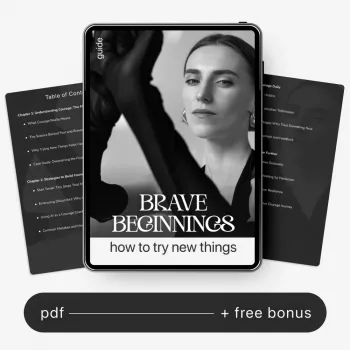
Brave Beginnings: How to Try New Things (Digital Guide) is designed for practical experimentation—simple exercises that reduce fear, build confidence through action, and help you return to the arena even after an awkward first try.
Why New Experiences Feel Hard (Even When They’re Good for You)
- Uncertainty triggers threat detection. The brain prefers familiar patterns over unknown outcomes, so “new” can register as “unsafe” even when it’s objectively fine. Stress responses can show up as racing thoughts, tension, or avoidance—common effects described by the American Psychological Association.
- Fear of judgment can outweigh the task itself. Many people can handle difficulty, but struggle with being seen as a beginner—especially in public or social settings.
- Perfectionism turns attempts into pass/fail tests. A first try becomes “proof” of competence (or lack of it) instead of practice that’s supposed to be messy.
- Avoidance brings short-term relief—and long-term anxiety. Skipping the thing works in the moment, but it teaches your brain that the only way to feel safe is to avoid, which can reinforce anxiety patterns (see general guidance from the National Institute of Mental Health).
What Courage Looks Like in Real Life
- Courage is acting with fear present, not waiting for fear to disappear.
- Confidence usually follows action. It’s often the result of collecting evidence: “I tried; I survived; I learned.”
- Progress is showing up and adjusting. Mastery is rarely instant; it’s built through information and iteration.
- A brave beginning can be five minutes. A small trial lowers the stakes while still proving capability.
If the concept of “exposure” sounds intimidating, it can be gentle and self-paced. Gradual, low-stakes exposure is a common behavior-change approach; Behavioral Scientist’s overview of exposure therapy explains how repeated, supported contact with a feared situation can reduce its power over time.
Inside the Digital Guide: Brave Beginnings
This guide is built to move you from stuck to starting without turning self-growth into an all-or-nothing project. Instead of hype, it focuses on a repeatable process: identify what’s really blocking you, choose a micro-step, run a short experiment, then reflect without self-criticism.
- A step-by-step structure designed to reduce overwhelm.
- Exercises to identify the real barrier (fear of failure, fear of judgment, uncertainty, lack of skills, lack of time).
- Tools to break goals into low-pressure experiments that are easier to begin and repeat.
- Reflection prompts that convert attempts into learning, not self-attack.
Quick snapshot
| Item | What it helps with |
|---|---|
| Starting framework | Turns “someday” into a clear first step |
| Micro-challenges | Builds momentum with manageable actions |
| Mindset prompts | Reduces harsh self-talk and perfection pressure |
| Progress tracking | Creates visible evidence of growth over time |
How to Use the Guide (Without Turning It into Homework)
The goal is not to “do it perfectly.” The goal is to make trying normal—something you can do on a random Tuesday, even when motivation is low.
- Pick one area to practice: social, skill-based, creative, fitness, career, or everyday life.
- Choose a “small enough” first attempt: something doable in 10–20 minutes.
- Set a trial window: one attempt, then a review—no long-term commitment required.
- Use an after-action review: What happened? What was harder than expected? What was easier? What’s the next smallest adjustment?
7-day courage practice plan
| Day | Action | Goal |
|---|---|---|
| 1 | Pick one new thing and define a tiny first step | Reduce ambiguity |
| 2 | Do a 10-minute trial | Create a first success |
| 3 | Repeat the trial with one small tweak | Build consistency |
| 4 | Add a light “stretch” (slightly harder version) | Expand comfort zone |
| 5 | Ask for a tip or feedback from a safe source | Lower fear of judgment |
| 6 | Practice again and track what improved | See progress clearly |
| 7 | Decide: repeat, scale up, or switch to a new experiment | Make action the habit |
Simple Courage-Building Techniques You Can Start Today
Who This Guide Fits Best
Getting Started: A Low-Stakes First Try
Helpful add-ons for new-start energy
- Adidas Men’s White Sneakers — a simple “I’m going out the door” cue for walks, casual meetups, or a first fitness class.
- Birkenstock Women’s White Leather Slippers — comfortable support for low-stakes at-home practice (creative time, journaling, stretching, or skill-building).
- Brave Beginnings: How to Try New Things (Digital Guide) — a repeatable system for turning “I should” into “I tried.”
FAQ
How do you build courage to try new things when anxiety is high?
Use tiny trials that feel safely doable, reduce uncertainty with a simple plan, and treat the goal as “show up once” rather than “be good.” Tracking small evidence of progress often works better than waiting to feel ready.
What if the first attempt goes badly?
Treat it as data: note what happened, what was harder than expected, and what you’d change next time. Make the next attempt smaller or add support, and remember that early awkwardness is a normal stage of learning.
How long does it take to feel more confident about trying new things?
Confidence usually follows repetition, not the other way around. A short practice window—like 7 to 14 days of small attempts—often creates noticeable ease, especially when consistency matters more than intensity.















Leave a comment