Find Purpose When Life Feels Lost: Small Steps That Work

Feeling Lost Doesn’t Mean You’re Broken
Feeling aimless can be disorienting—especially when motivation disappears and decisions feel heavy. Purpose rarely arrives as a lightning-bolt realization. More often, it’s rebuilt through small, repeatable steps that reconnect values, strengths, and daily choices. The goal isn’t to “figure out your whole life.” It’s to create enough calm and clarity to take the next right step—and let direction emerge as you move.
If stress or overwhelm is running the show, it can help to learn what supports well-being and coping. The American Psychological Association discusses how meaning and purpose relate to well-being, and the National Institute of Mental Health outlines practical ways to cope with stress when life feels heavy.
When life feels lost: common signs and what they’re really pointing to
“Lost” often looks less dramatic than people expect. It can show up as chronic indecision, emotional numbness, going through the motions, frequent comparison, or a persistent sense of drifting. These signs can point to a direction problem—not a capability problem.
Motivation usually can’t lead when clarity is missing. Motivation tends to follow meaning and progress. When actions connect to something that matters (even slightly), energy is more likely to return.
Transitions amplify the feeling: graduation, career changes, breakups, grief, relocation, burnout, or an identity shift. When the old structure falls away, it’s common to feel unmoored before a new one forms.
A quick grounding step: name what feels missing. Is it connection, growth, contribution, stability, creativity, or freedom? Putting a single word on the gap reduces overwhelm and gives you a clearer target.
Stabilize first: create enough calm to hear what matters
Before hunting for a grand purpose, stabilize your basics. A dysregulated body makes everything feel harder, including reflection and decision-making.
A 7-day “minimum stability” routine
- Sleep window: pick a realistic bedtime/wake-time range and aim for consistency.
- Hydration: add one extra glass of water daily.
- One nourishing meal: keep it simple and repeatable.
- 10-minute walk or stretch: movement is a reset button.
- One small tidy task: one surface, one drawer, one bag—done.
Reduce noise by limiting scrolling or comparison triggers. Replace them with one soothing input: music, reading a few pages, a short nature break, or journaling.
Use a 2-minute reset when spiraling
- Slow your breathing for 4–6 cycles.
- Label the emotion (“anxious,” “sad,” “stuck,” “overwhelmed”).
- Choose one next action that is small enough to do now.
If hopelessness, panic, or inability to function persists, consider reaching out to a licensed mental health professional for support.
Clarify values: what matters even when everything changes
Values work best as decision-compasses, not personality labels. They’re the principles you want your choices to reflect, even when circumstances shift.
Try a simple “values sort”
- Choose 10 values that resonate (examples: growth, freedom, stability, creativity, learning, family, service, integrity, health, community).
- Narrow to 5 by asking: “If I could only keep five, which would hurt most to lose?”
- Define each in one sentence: “For me, health means…”
Next, look for value conflicts—like freedom vs. security, achievement vs. presence. Naming the trade-off often dissolves the “stuck” feeling because it turns vague tension into a clear choice.
Finally, translate values into behaviors. Purpose becomes actionable when each value shows up as observable actions you can do in a normal week.
| Value | How it can look this week | Tiny start (5–10 minutes) |
|---|---|---|
| Growth | Learn one skill or concept; reflect on lessons | Watch a short tutorial and write 3 takeaways |
| Connection | Reach out intentionally; share honestly | Send one thoughtful message to a friend |
| Health | Move and fuel the body consistently | 10-minute walk after a meal |
| Creativity | Make something imperfect on purpose | Sketch, draft, or brainstorm 10 ideas |
| Contribution | Help in a way that fits capacity | Answer one question or offer one small favor |
Reconnect with strengths and energizers: clues hidden in past moments
When purpose feels distant, borrow evidence from your own history. You don’t need a perfect calling; you need reliable clues.
Energy mapping (fast and revealing)
Avoid the passion trap. Instead of searching for one flawless destiny, focus on what’s workable and meaningful now. If you want a philosophical overview of how people think about meaning, the Stanford Encyclopedia of Philosophy offers a helpful foundation.
Run purpose micro-experiments: discover direction by doing
Turn insights into a next-step plan: clarity that survives real life
Write a working purpose statement
Set one 30-day direction
Design your environment and plan for setbacks
A structured workbook option for guided self-discovery
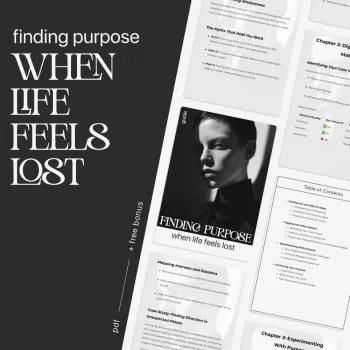
A helpful option is the Finding Purpose When Life Feels Lost printable workbook, which is designed for values, strengths, reflection prompts, goal-setting, and action planning.
For micro-experiments that involve movement or getting outside, supportive basics can help remove friction—like Adidas Men’s White Sneakers for a daily walk routine or a hands-on hobby experiment like the Carbon Trout Fishing Combo if nature, patience, and skill-building energize you.
FAQ
How long does it take to find purpose when life feels aimless?
It’s usually gradual. Two-week experiments can surface patterns quickly, and a 30-day plan helps you turn those insights into steady momentum.
What if nothing feels interesting right now?
Numbness is common with burnout or prolonged stress, so start by stabilizing basics and reducing overwhelm. Choose low-effort experiments based on values (like connection or health) rather than waiting for excitement to appear.
Can a workbook actually help with self-discovery?
Yes—structured prompts reduce decision fatigue, help you track patterns over time, and turn insights into doable steps. Consistency matters more than intensity, so a simple weekly check-in often works better than occasional deep dives.















Leave a comment