Blockchain Investor Checklist: Screen Tokens Fast

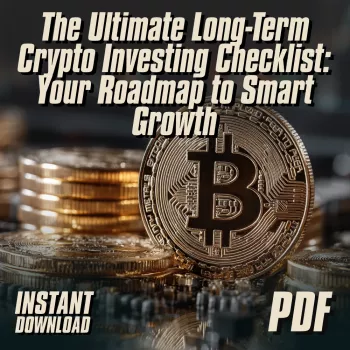
Blockchain Like a Boss: A No-Fluff Investor’s Checklist (Digital Download)
Blockchain investing can move at a pace that rewards speed, but punishes sloppy judgment. Between technical jargon, fast-changing narratives, and social-media certainty, it’s easy to confuse momentum for fundamentals. “Blockchain Like a Boss” is a digital checklist built to make decisions calmer and more consistent: a practical sequence of questions and quick tests to evaluate risk, spot weak claims early, and document what needs to be true for an investment thesis to hold up.
If you want a reusable framework you can apply across different tokens and protocols—without drowning in hype—the downloadable checklist is designed to help you screen faster, verify smarter, and compare opportunities using the same standards each time.
What the checklist helps decide (and what it avoids)
The biggest upgrade an investor can make is moving from “Does this sound exciting?” to “Does this survive basic scrutiny?” This checklist is built around decision signals that tend to matter across cycles.
- Does this even need a blockchain? It prompts a clear test: what breaks if one party runs the system? If “nothing,” the blockchain label may be marketing, not architecture.
- Is there real utility and credible security? It centers on utility, security assumptions, token incentives, governance, and adoption evidence—rather than vibes.
- Is the narrative replacing proof? It deliberately reduces reliance on price predictions, influencer confidence, and vague “soon” roadmaps.
- Can projects be compared apples-to-apples? It uses repeatable questions so different opportunities can be evaluated with the same yardstick.
- Is the process efficient? It’s designed for quick screening first, and deeper verification only when a project passes the basics.
For broader investor education and risk context, it helps to review regulator resources like the FINRA crypto assets overview and the CFTC customer advisories on virtual currencies.
Quick-start: a 15-minute screening flow
Not every project deserves hours of research. The checklist begins with a tight screening flow meant to protect time and capital.
- Problem/need: Name the real-world problem in one sentence. If the sentence turns into a paragraph of buzzwords, pause.
- Value capture: Identify who benefits and who pays. Confirm the token’s role isn’t optional or easily replaced.
- Reality check: Verify something exists now—demo, repository activity, working app, credible usage data, or observable on-chain activity.
- Team and accountability: Look for identifiable leadership, relevant experience, and a public track record you can verify.
- Risk flags: Watch for concentrated token ownership, unclear custody, aggressive yield claims, and a vague or evasive compliance stance.
- Decision gate: If two or more major items fail, skip the deep dive and move on.
This is where investors often win by avoiding losses—not by finding the “perfect” winner, but by declining projects that can’t clear basic credibility hurdles.
Due diligence pillars inside the checklist
When a project passes the first screen, the checklist guides a deeper review using a few durable pillars.
- Use-case fit: Why is decentralization required? What fails if a central operator controls the system?
- Architecture basics: Chain choice, consensus model, security trade-offs, and dependency risks (especially bridges and oracles).
- Token design: Supply schedule, emissions, lockups, vesting, and whether “utility” is real or just a cover for speculation. Claims like burn/mint mechanics are treated as testable, not magical.
- Governance: Who can upgrade contracts, change parameters, pause transfers, or alter fees—and what safeguards exist against misuse?
- Adoption signals: Active users, retention, developer activity, and partnerships that can be verified beyond screenshots.
- Transparency: Clear docs, audit reports (and what they actually found), incident history, and plain-language disclosures.
Red flags the checklist is built to catch early
Many blowups share a small set of warning signs. The checklist elevates them so they’re harder to ignore.
- Guaranteed returns or fixed high yields without clear risk explanations, plus pressure to act fast.
- Token “utility” that’s only narrative—“community,” “future ecosystem,” or “number go up” positioning.
- Unverifiable partnerships, link-free announcements, or “stealth” teams managing public funds.
- Complexity without purpose: multiple tokens, multiple chains, wrappers, and layers with no clear end-user benefit.
- Security shortcuts: unaudited contracts, new bridges, admin keys with broad control and no meaningful safeguards.
- Liquidity traps: thin liquidity, heavy unlocks approaching, or incentives that vanish quickly.
Beginner vs. experienced investor: how to use the same checklist differently
The same questions work at different depths. Beginners use the checklist to avoid preventable mistakes; experienced investors use it to pressure-test edge cases.
How the checklist scales by experience level
| Area | Beginner focus | Experienced focus |
|---|---|---|
| Custody & access | Use reputable exchanges/wallets; avoid unknown links | Multi-wallet hygiene; hardware wallet ops; smart-contract interaction risk |
| Project evaluation | Simple utility and red flags first | Token mechanics, governance attack surface, dependency risk mapping |
| Risk controls | Small sizing; avoid leverage; clear exit rules | Scenario analysis; liquidity modeling; hedging and correlation review |
| Information sources | Primary docs + reputable regulators | On-chain data, audit diffs, protocol analytics, governance history |
Putting it into practice: a repeatable decision log
What’s included in the digital download
In-stock picks
- Blockchain Like a Boss: The No-Fluff Investor’s Checklist (Digital Download)
- Adidas Men’s White Sneakers
FAQ
Is this checklist useful if blockchain is completely new?
Yes. It’s designed to guide evaluation without requiring a deep technical background, using a fast screening flow, clear red flags, and plain-language prompts that get easier to apply with repetition.
Does the checklist provide financial advice or specific coin picks?
No. It’s an educational framework for evaluating projects and documenting decisions, not a recommendation list. Personal risk tolerance and, where appropriate, professional guidance still matter.
How often should the checklist be re-used for the same investment?
Re-run it after major events such as upgrades, audits, token unlocks, governance changes, or exploits, and also on a regular cadence that matches your time horizon. The decision log’s invalidation triggers help determine when a re-check is non-negotiable.















Leave a comment