Decisive Living: A 6-Step Framework for Confident Choices

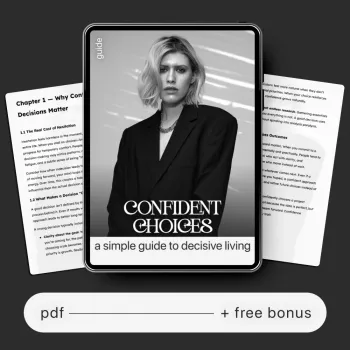
Confident Choices: A Simple Guide to Decisive Living
Decisions shape days, relationships, work, money, and health—yet many choices get delayed by overthinking, fear of regret, or too many options. A decisive life isn’t about always being right; it’s about using a simple process, acting on what matters, and recovering quickly when outcomes change. The goal is calmer follow-through: make a call, take the next step, and evaluate at a planned checkpoint instead of replaying the decision on repeat.
Why decisions feel hard (and why that’s normal)
Indecision often looks like a personal flaw, but it’s usually a predictable mix of brain limits and modern overload. A few common reasons decisions get sticky:
- Analysis overload: too much information makes it harder to rank what matters most.
- Fear of regret: the mind tries to avoid future disappointment by delaying commitment.
- Perfectionism: treating everyday choices like irreversible life moves increases pressure.
- Decision fatigue: willpower and attention drop after many small choices in a day (a widely discussed topic in behavioral research; see the National Library of Medicine overview at https://www.ncbi.nlm.nih.gov/).
- Ambiguous goals: when values aren’t defined, trade-offs feel confusing and personal.
Stress also narrows attention and can reduce self-control, which makes choices feel heavier than they “should” (American Psychological Association: https://www.apa.org/topics/stress). Add cognitive bias—systematic mental shortcuts that distort judgment (Britannica: https://www.britannica.com/topic/cognitive-bias)—and it becomes clear why even simple decisions can stall.
A simple decision framework that works in real life
When everything feels important, the solution isn’t more thinking—it’s a smaller, repeatable structure. Use this six-step framework:
- Name the decision in one sentence and set a deadline (even a small one).
- Define the purpose: what problem is being solved, and what “good enough” looks like.
- Choose 3 criteria only (examples: cost, time, impact, alignment with values).
- Limit options: cap at 3–5 choices to prevent spiraling comparisons.
- Pick, then plan: decide the next two actions that make the decision real.
- Commit to a review point: decide when to evaluate and adjust, instead of re-litigating daily.
This works because it turns a vague mental loop into a short sequence: clarify, constrain, choose, act, then review.
Quick decision templates for common situations
| Situation | 3 Criteria to Use | Time Limit | Next Two Actions |
|---|---|---|---|
| Everyday purchase | Budget fit; durability; usefulness this month | 10 minutes | Buy or skip; log the choice for review |
| Career/work choice | Growth; stability; values alignment | 48 hours–2 weeks | Talk to one mentor; write a 1-page pros/cons using criteria |
| Health habit | Simplicity; consistency; measurable outcome | 30 minutes | Schedule it; set a reminder + tracking method |
| Relationship conversation | Clarity; kindness; timing | 24 hours | Draft 3 talking points; choose a time to talk |
| Big life decision | Long-term fit; opportunity cost; support system | 2–6 weeks | Run a “small test”; set a formal decision date |
Build confidence before the choice: clarity tools that reduce doubt
Confidence usually improves before the decision, not after. These tools reduce the “but what if…” noise so the choice feels cleaner.
- Values check: list 5 values, then rank the top 2 for this specific decision.
- Regret test: imagine it’s 6 months later—what would cause regret: choosing, or not choosing?
- Opportunity cost lens: ask what this choice prevents (time, money, energy).
- Minimum viable decision: identify the smallest step that creates learning without full commitment.
- “Good, better, best” planning: prepare three acceptable paths so the mind stops chasing perfect.
If you’re stuck between “keep researching” and “pick something,” aim for a minimum viable decision: a small action that reveals real-world information. Learning reduces fear faster than rumination.
Act decisively: make the decision stick
Decisiveness isn’t just selecting an option—it’s making it real. Follow-through is where second-guessing usually tries to sneak back in.
Recover fast when outcomes aren’t ideal
A practical digital guide to decisive living
If you want a ready-to-use system you can apply in minutes, Confident Choices: A Simple Guide to Decisive Living (digital self-growth guide) is built to turn indecision into a repeatable process. It’s designed for everyday choices and bigger transitions—work, routines, relationships, spending, and personal goals—without requiring complex systems or endless journaling.
For decisions tied to spending, pairing decisiveness with simple money rules helps prevent “buyer’s remorse spirals.” Shop Smart, Save Big: The Ultimate Guide to Cutting Costs Without Cutting Corners can help you set clearer budget guardrails so purchase decisions feel calmer and faster.
And when you’re applying the framework to an everyday purchase, it helps to pick a short list and commit to criteria like comfort, durability, and price. If you’re narrowing footwear options, compare a couple of finalists like Calvin Klein Jeans Women’s Sneakers and New Balance Women’s Grey Fall/Winter Sneakers using only three criteria, set a 10-minute limit, and move on.
FAQ
How can decisions be made faster without making careless mistakes?
Set a deadline, limit your options to a short list, and use only three criteria to compare them. Then commit to a scheduled review point so adjustments are planned rather than reactive.
What helps with fear of regret after making a decision?
Write down your reasoning at the time so you don’t rewrite history later. Accept uncertainty as normal, and evaluate at a pre-set checkpoint with a focus on learning instead of replaying the choice.
How can decision fatigue be reduced during busy weeks?
Batch small decisions, standardize routines (like meals or outfits), and save high-stakes choices for peak-energy hours. Reduce friction with automation, reminders, and simple checklists.















Leave a comment